Using the Four PLC Questions to Deepen Your Competency-Based Learning Work
A blog article written by Jonathan Vander Els and Brian M. Stack with contributions from our colleague and fellow co-author Karin Hess
For more than a decade, we’ve watched schools transform their instructional, assessment, and support systems by bringing together two powerful ideas: competency-based learning (CBL) and the Professional Learning Community (PLC) at Work process. Each is powerful on its own—but when woven together intentionally, they create the conditions for equitable, student-centered learning that is both rigorous and deeply meaningful.
In our 2024 book, Elevating Competency-Based Learning in a PLC at Work, we introduced a set of tools designed to help teams reflect, calibrate, and refine their practices as they build a defensible body of evidence and cultivate a system where every learner can grow and thrive. Among these, IMPACT Tool 11 stands out as one of the most actionable, practical entry points for teams ready to take their next steps.
What is IMPACT Tool 11?
IMPACT Tool 11 was created by adapting a tool first developed by Bill Ferriter in his 2020 book: Big Book of Tools for Collaborative Teams in a PLC at Work. The adapted tool, following the same thought process, helps teams examine their competency-based work through the lens of the Four Critical Questions of a PLC. These questions—originally posed by Rick and Becky DuFour, Bob Eaker, and the architects of the PLC at Work model—establish a clear framework for collective responsibility and continuous improvement:
What do we want students to know and be able to do?
How will we know if they have learned it?
How will we respond when they haven’t learned it?
How will we extend the learning for students who are already proficient?
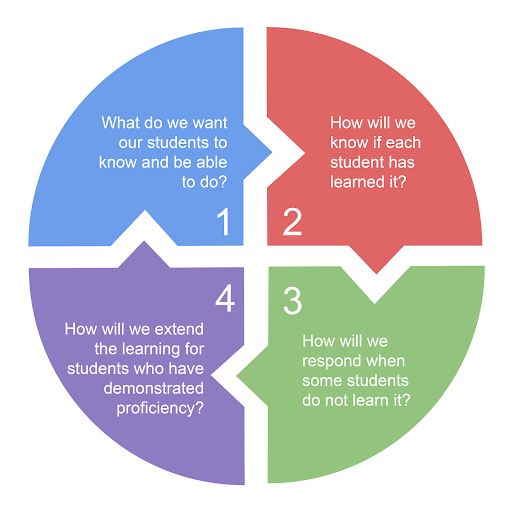
The Four Critical Questions of a PLC
For years, we’ve used these four questions as the engine that drives collaborative work.
With IMPACT Tool 11, we take the next step: We connect each PLC question to the core design principles of CBL—clarity, transparency, personalization, transfer, and equity.
Why This Tool Matters
Schools often begin their CBL journey with clarity about the “why,” but uncertainty about the “how.” IMPACT Tool 11 bridges that gap. Its strength is its simplicity: each PLC question is unpacked into a series of CBL-aligned tasks, and teams self-assess whether they are:
Already doing this
Ready for this now
Not ready for this yet
This structure makes IMPACT Tool #11 ideal for teams to get specific with schoolwide reflection, team-based goal setting, and strategic planning. Most importantly, it keeps the work grounded in practice—not theory.
Using the Tool to Strengthen Your CBL Alignment with the PLC Model
Here’s how each PLC question becomes a lever to deepen competency-based practice.
PLC Question 1: Clarifying Learning Expectations
PLC Critical Question #1
CBL demands crystal-clear expectations for learning. The tool prompts teams to refine:
competency statements requiring that students transfer/apply learning
essential academic standards that support success on competencies
student-friendly learning targets (“I can…” statements)
prerequisite skills suggesting possible learning entry points
performance levels and rigorous cognitive demands (DOK) describing deeper learning
Teams examine whether their curriculum truly reflects endurance, leverage, and readiness, and whether students understand what proficiency looks like. This isn’t about rewriting everything. It’s about establishing a guaranteed and equitable curriculum—one that gives every student access to rigorous, transferable learning.
PLC Question 2: Building a Defensible Body of Evidence
PLC Critical Question #2
The heart of CBL is collecting ongoing high-quality evidence of learning. The tool guides teams to:
map a variety of assessment types across a unit or course
design and use common formative assessments to monitor progress
use pre-assessments that assess pre-requisite skills
create performance scales describing entry points and learning pathways
validate performance-based academic and POG assessments and rubrics
collaboratively score student work
This work ensures that teams aren’t just collecting evidence—they are collecting meaningful, actionable, and aligned evidence that illuminates learning and supports students in moving along a progression.
PLC Question 3: Responding With Students Who Need Support
PLC Critical Question #3
CBL and PLCs share a common commitment: No student should fall through the cracks. The tool helps teams develop systems for timely, targeted support by:
identifying content-specific common misconceptions
using data to analyze effective (and ineffective) reteaching strategies
designing progress checks
monitoring growth using varied assessment formats
sharing successful intervention strategies across teams
This moves intervention from an individual teacher effort to a team-based, system-level commitment.
PLC Question 4: Extending Learning for Students Who Are Ready
PLC Critical Question #4
Too often, schools excel at remediation but struggle to provide equitable extension for students already demonstrating proficiency. The tool shifts this narrative by prompting teams to:
identify personalized extension pathways
support student-designed challenge tasks
curate strategies supporting student agency
build assessments for collaborative advanced learning
share promising practices across teams
This ensures that every learner—not just those below benchmark—benefits from personalized instruction.
How Schools Can Use the Tool
Teams we work with often use this tool in some of these ways:
At the beginning of the year with their guiding coalition to set goals for their CBL implementation plan
During teacher collaborative team meetings to guide conversations about curriculum, assessment, and support
As part of a schoolwide effort to build common language and expectations
Midyear or end-of-year as a reflection and calibration process
To align evidence-gathering practices when building a defensible body of evidence of learning
The tool doesn’t dictate the work—it illuminates it. It helps teams see where they are strong, where they are emerging, and where they need to prioritize next steps.
Final Thoughts
Competency-based learning thrives when clarity, collaboration, and collective responsibility are present. Our IMPACT Tool 11 gives teams a roadmap for ensuring their practices reflect those commitments.
As you continue to deepen your work, let this tool spark the conversations that matter most. The goal is not perfection—it is progress. And progress becomes possible when teams commit to the everyday, disciplined work of aligning their PLC processes with the principles of a competency-based system.